THE SCIENCE OF TAKING BACK CONTROL
Reclaiming responsibility is where resilience turns into forward motion. Neuroscience tells us our brains are wired to protect us — which often means they keep us stuck. When the amygdala (our “danger detector”) is in overdrive, it shuts down the prefrontal cortex — the part of the brain that helps us problem-solve, plan, and move forward.
Reclaiming responsibility is how we get our “CEO brain” back online. It’s not about blame — it’s about curiosity. It’s about treating our lives like experiments: testing beliefs, running new mental models, and collecting data to make better decisions.
PERSONAL STORY: HOW EXPERIMENTS SAVED MY LIFE
When neurologists diagnosed me with an inoperable spinal cyst and gave me months to live, my dad became the ultimate scientist. He refused to accept “no” as the final word. Instead, he reframed it: N.O. = Next Opportunity. He challenged every conclusion, ran experiments, and persistently asked questions until we found a solution that saved my life.
Years later, I faced my own darkest moment. After a spinal surgery went wrong, I was left with a broken leg in eight places, crushing nerve pain that made it impossible to think clearly, and a body that felt like it had turned against me. I couldn’t work. I couldn’t form a sentence. And I didn’t want to keep living.
That’s when I came across the story of William James, the father of American psychology. He once decided to spend one year taking complete responsibility for his thoughts, beliefs, and actions — to see if life could become bearable. If nothing changed, he would end his life.
I followed his lead. For one year, I committed to reclaiming my thoughts, my choices, and my next steps — no matter how small. And here’s what happened: I learned to navigate the insurance system, wrote hundreds of appeals backed by peer-reviewed research, and won case after case — including the one for my power seat elevator. When my insurer told me, “This is not a precedent — you cannot use this to help others,” I decided that was unacceptable.
So I joined a coalition of advocates, went to Capitol Hill, and three years later, Medicare reclassified power seat elevators as medically necessary. Millions of wheelchair users gained access to life-changing equipment — and I gained proof that reclaiming responsibility doesn’t just change your life. It can change the system for everyone.
BEING THE SCIENTIST IN YOUR LIFE
Your brain loves shortcuts — called heuristics — that make decision-making easier. But those shortcuts often lead to cognitive biases, mistaken beliefs, and self-limiting stories.
Reclaiming responsibility means becoming the scientist in your own life:
- Your values + beliefs = your hypotheses. Are they really true, or just old defaults?
- Your actions = your experiments. Do they get you closer to what matters, or just keep you busy?
- Your results = your data. Are you learning and adjusting, or repeating the same cycle?
When you treat growth like an experiment, there’s no such thing as failure — just F.A.I.L.: First Attempt In Learning.
Professional Application:
At work, reclaiming responsibility means refusing to get stuck in decision limbo. Instead of waiting for the perfect plan, teams ask:
- What action is ours to take right now?
- How can we turn this “no” into data for the next attempt?
- What experiment can we run to move forward, even by 1%?
This creates cultures of ownership, speeds up innovation, and transforms “failure” into feedback loops.
Personal Application:
Reclaiming isn’t just for boardrooms — it’s for everyday life. The next time you feel powerless, write down three things still in your control. Your mindset. Your next question. Your next small action. Pick one and do it within 24 hours.
This simple act reminds your brain it still has agency — shifting you from paralysis to power.
Wrap Up:
Reclaiming responsibility doesn’t mean carrying the weight of the world. It means deciding what’s yours to carry, experimenting, and adjusting until you get it right.
Stop waiting. Start experimenting. Learn from it.
Because “no” isn’t the end of your story — it’s just the start of your next hypothesis..

This was me in the ICU after emergency spinal surgery in China. Doctors told me I might not survive, and if I did, they did know what kind of quality of life I would have. I remember lying there, terrified, wondering if this was the end of my story.” This image marks the moment everything changed. It’s not just a hospital photo — it’s the snapshot of the day my life, my identity, and my future were thrown into chaos. This is where the seed of reclaiming responsibility was planted, even if I didn’t know it yet.
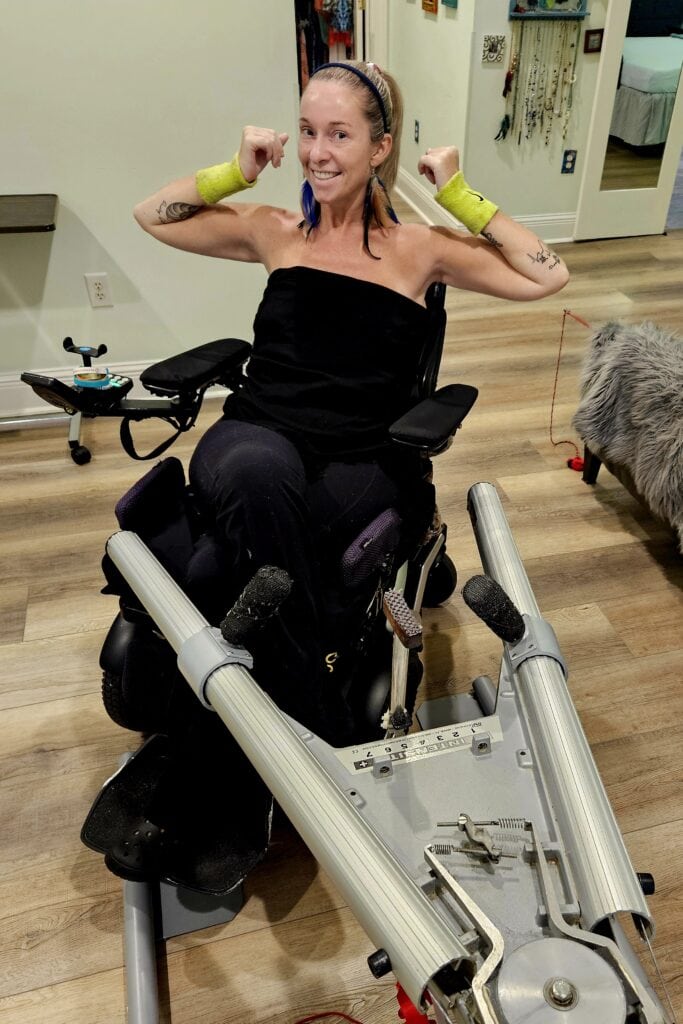
And this is me years later — rocking it out, literally. After countless setbacks, surgeries, and insurance battles, I chose to take back control, one decision at a time. This is what reclaiming responsibility looks like: stronger, more alive, and maybe a little sassier. This image shows the other side of the story — the result of refusing to stay stuck. It’s proof that my year-long experiment worked: I didn’t just survive; I rebuilt a life I love, fought for systemic change, and found my strength (and my humor) again.
TWO THINGS FOR YOU TO THINK ABOUT
- Reclaiming responsibility isn’t about taking the blame for everything that’s gone wrong — it’s about owning your next move.
- The difference between stuck and unstoppable? It’s deciding that “No” isn’t the end of the story.
TWO THINGS FOR YOU TO ASK YOURSELF
- Where am I waiting for someone else to fix, decide, or lead — when I could take one small action?
- What’s one belief I’ve never questioned that might be quietly running my decisions?
ONE THING FOR YOU TO TRY THIS WEEK
- The next time you hit a wall — literally or metaphorically — pause and ask: “What’s my experiment here?” Treat the situation like a scientist would: test a new thought, a new approach, or even a new question. Notice what data it gives you. That’s growth.
Remember: Responsibility isn’t about fault. It’s about reclaiming your role as the scientist in your own life — running experiments, collecting data, and adjusting until you find what works. “No” just means Next Opportunity, and FAIL? That’s simply your First Attempt In Learning.