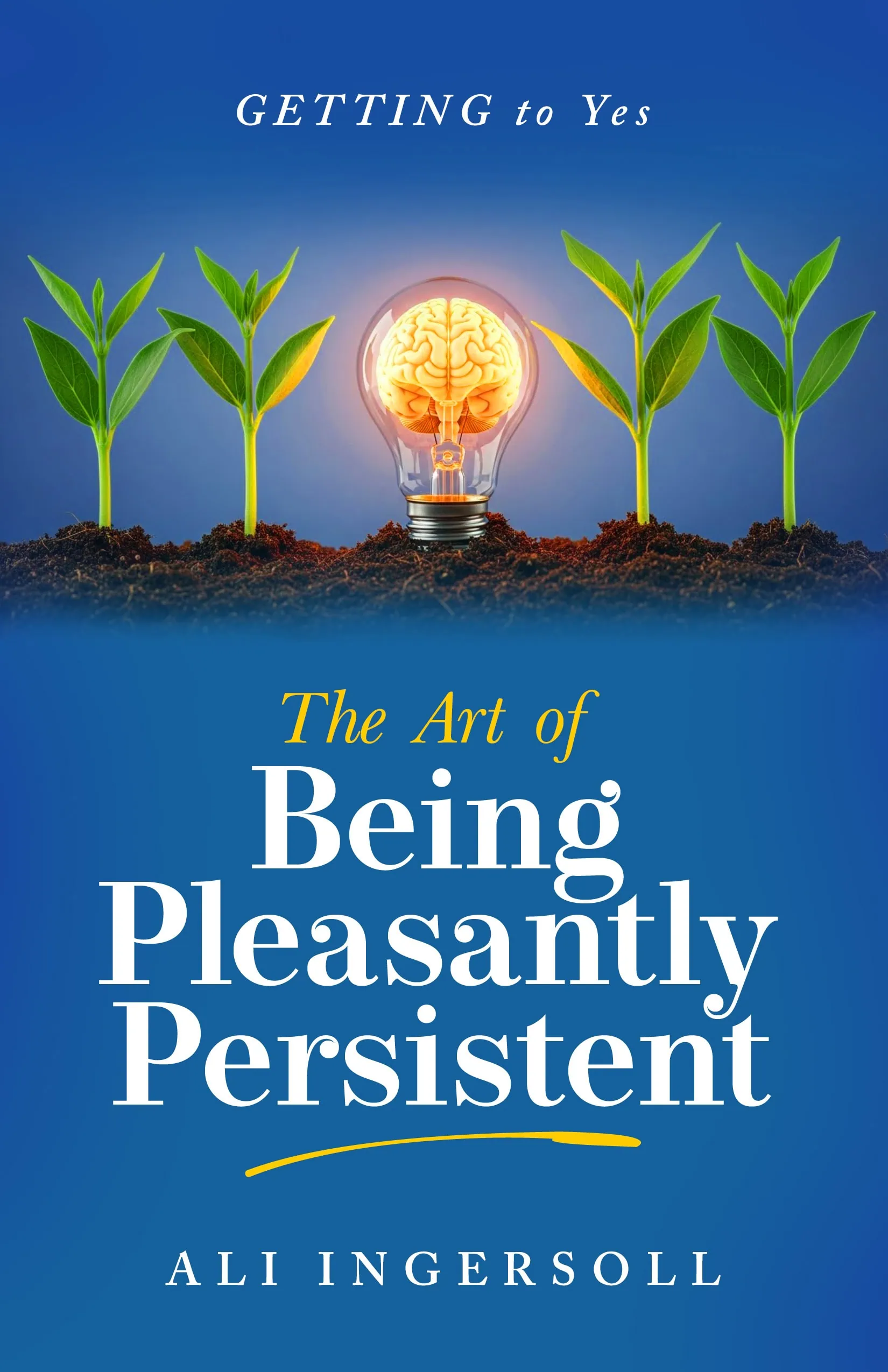
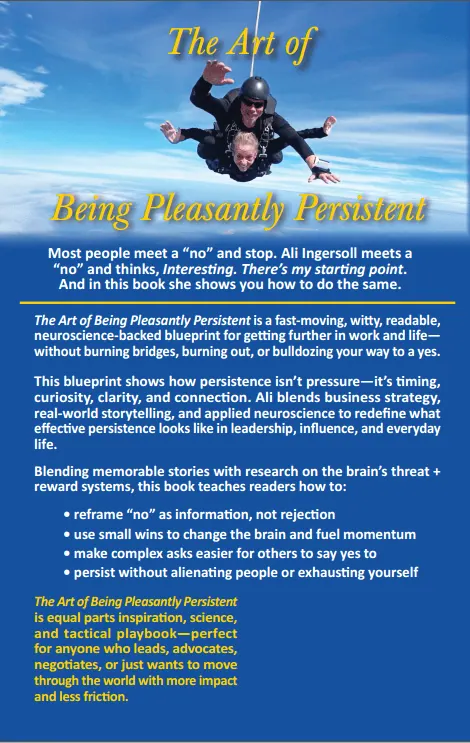
I didn’t invent the mindset of “being pleasantly persistent.” But I absolutely gave it a personality and perhaps coined the term 😊
It started as a joke I made during an insurance appeal call. I was explaining why I was emailing again—without yelling, crying, or sending glitter bombs—and I told them, “Don’t worry, I’m not mad… I’m just pleasantly persistent.”
They laughed. I got what I needed. And the phrase stuck. Since then, it’s become my go-to phrase for how I operate in the world: not pushy, not passive, but committed, curious, and never above a creative follow-up.
Here’s the thing: Persistence gets a bad rap. It’s often seen as aggressive, annoying, or exhausting. But when done with intention and empathy, persistence becomes one of the most powerful tools you have—especially when building relationships, leading others, or advocating for yourself.
The Science of Showing Up (Again and Again)
if you will allow me, let’s get nerdy for a moment. Your brain—and everyone else’s—is constantly scanning for safety and predictability. That’s why we tend to trust what we repeatedly see. It’s called the mere exposure effect: the more often something (or someone) shows up in a positive way, the more our brains associate them with reliability.
Combine that with mirror neurons (which help us read others’ intent), and your repeated presence—especially when it’s calm, friendly, and value-driven—starts to rewire how others respond to you.
In short: being pleasantly persistent builds trust by teaching other people’s brains that you’re consistent, safe, and worth listening to.Even better? Repetition strengthens your own neural commitment too. Every time you follow through or circle back, you reinforce your own sense of agency and clarity. And that internal feedback loop becomes its own kind of power.
So Why Does It Matter?
Because most people give up too soon.
We tell ourselves silence means “no,” or that following up makes us annoying. But neuroscience tells a different story: most relationships—personal, professional, even systemic—are shaped by the people who keep showing up without demanding instant results.
That’s not persistence with pressure. That’s persistence with presence. And that kind of presence is magnetic.
A Working Framework: The Pleasantly Persistent Mindset
Here’s how I break it down:
- Humorous – Because honestly, if you can’t laugh at the process, you’ll probably rage-quit it.
- Intentional – You’re not following up out of fear or obligation, but with purpose and clarity.
- Relational – You’re thinking about the human on the other side, not just the outcome.
- Rhythmic – You don’t stalk. You don’t spam. You keep a steady, thoughtful pulse.
Personal Story
I never recommend anything I haven’t tested extensively in my own life—I’m the chief scientist in my personal laboratory of perspective. And I know you’re doing the best you can with your own experiments too.
In 2016, I spent an entire year in bed with a pressure sore—one that went all the way down to the bone. By that point, I had already lived in and out of hospitals for five years, dealing with multiple pressure sores, failed surgeries, and enough medical debacles to write a trilogy.
I was being denied medically necessary equipment I needed to physically survive. So instead of wallowing through another year in bed, I made a decision: if I couldn’t change my body’s reality, I could change my perspective on how to live inside it.
I built myself a schedule. I taught myself how to navigate the health insurance appeals process. I started writing my own letters of medical necessity.
Because let’s be honest—at that point, I had nothing but time. This is where the mindset of being pleasantly persistent was born. Every denial got a reply. Every appeal got filed. Because I knew most patients—and frankly, most healthcare providers—don’t.
In fact, according to the Kaiser Family Foundation, only 1/10 of 1% of denied medical claims in the U.S. were appealed in 2022. Yep. You read that right.
I didn’t want to be a statistic. So, I tried something different. I chose to stay in the ring. Not with rage—but with resolve. Denial after denial. Letter after letter. One quiet act of defiance at a time.
Over time, I began to learn the ins and outs of the U.S. healthcare system—not because I wanted to, but because I had to. And what it taught me became something I carry into every speech, every struggle, and every story:
We are what we think.
(Kind of like “we are what we eat,” but with more policy loopholes and fewer carbs.)
Our thoughts can paralyze us—or propel us. Sometimes it’s just about taking one small step forward, or in my case, reading one line of corporate policy that could change everything.
The trick? Don’t give up. (Or, at least, don’t give up permanently.) There will be days where you throw your hands up. That’s okay. Take the day. Take the moment. But the next day—or the next week—try again.
Most importantly: be kind to yourself.
I’m guilty of beating myself up too, for not doing enough or not moving fast enough. But that’s why I lean on daily gratitude practices—simple, grounding things that keep me connected to myself. And I encourage each of you to find your own.
Professional Application:
Here’s the truth: In business and leadership, the person who shows up consistently—without demanding immediate results—is often the one others learn to trust the most.
Persistence isn’t about pestering. It’s about presence.
Ask yourself:
- Where am I expecting instant results in a relationship that actually needs rhythm?
- What could I build if I stayed just 10% longer than most people do?
Whether you’re leading a team, pitching a client, or driving change inside your organization, pleasant persistence becomes a competitive advantage.
That means:
✔️ Follow up without apology
✔️ Offer value with each touchpoint
✔️ Let relationships grow on their timeline—not just yours
Because leadership isn’t about pushing—it’s about being the one who doesn’t quietly disappear.
Personal Application:
Let’s be real: persistence is easy to admire in others… and hard to apply to ourselves without spiraling into burnout or passive-aggressive Post-it notes.
Here’s how to practice being pleasantly persistent in your actual life:
With yourself:
Set reminders for what matters. Not just deadlines and meetings—but joy, rest, connection. Calendar the stuff you keep saying is important but never make time for. (Yes, even calling your dentist counts.)
With your self-doubt:
That little voice that says, “You’ve already failed three times, why bother?” Politely tell it:
“Thanks for your input. I’m choosing persistence over perfection today.”
Then do one small thing anyway—something bite-sized and momentum-friendly.
With your family (or whoever tests your spiritual stamina):
Try curiosity over confrontation. Ask:“Would it help if I followed up again later?”
Then give yourself bonus points for not losing your mind when they answer “yes.” Persistence doesn’t mean bulldozing your way through. It means believing it’s still worth showing up, even if you’re doing it with a raised eyebrow and a coffee IV.
Wrap Up:
Pleasant persistence isn’t about being the loudest voice in the room. It’s about being the one who’s still standing when the noise fades—calm, steady, and ready to keep building something that matters.
It’s not always easy. It’s not always fast. But it is always worth it. So send the follow-up. Take the next small step. Remind the world—and yourself—why it matters.
Because you don’t need to bulldoze your way through life. You just need to keep showing up like you mean it.

Through consistent relationship building I had the beautiful opportunity to present to the Becton Dickinson (BD) Global Leadership Meeting over the last month. BD is one of the leading manufacturers of medical technology. Through consistent persistence, working with the team on multiple patient health advocacy projects, and pleasantly following up… This led me to the most beautiful opportunity to help leaders in this multinational corporation appreciate that one person can change a life even if only with a piece of paper.
TWO THINGS FOR YOU TO THINK ABOUT
- Persistence isn’t just about pressure—it’s about timing, trust, and the willingness to show up again (and again) when others stop.
- Most people stop following up because they assume silence means “no.” But in reality? It often just means “Next Opportunity.”
TWO THINGS FOR YOU TO ASK YOURSELF
- What does being persistent look like without being pushy?
- Where in my life is it worth following up again?
ONE THING FOR YOU TO TRY THIS WEEK
- Pick one thing you’ve been hesitating to follow up on—a conversation, a proposal, a request—and send a second message that adds value (not pressure). Keep it short, clear, and rooted in service.
Remember: Being pleasantly persistent isn’t about pushing harder. It’s about sticking around long enough to build something real.